What is MyMedia Games Network Retrospective?
MyMedia Games Network Retrospective is a regular feature that will take a look at various video game systems, technological advancements and accessories from the past. This may be a trip down memory lane for some people or a history lesson for others. Over time many companies have contributed to the video game industry in their own way, whether it’s a revolutionary step forward for others to follow, or a prime example of what not to do. With that said, let’s take a peek into the past.
Hardware add-ons from the 16bit era
Today’s current generation of video-game consoles pretty much comes packaged with everything you need straight out of the box. Features like backwards compatibility, online gaming and enough processing hardware to keep the majority of consumers and developers happy for years to come. Back during the fourth generation of consoles - also known as the 16bit era - the three main competitors in the home console industry for that time released various hardware add-ons to provide the added extras we take for granted in our current generation consoles. Some provided enhanced graphics and larger storage mediums; some unlocked the gaming library from the predecessor console and the list goes on. I bet many people that bought a Super Nintendo or Sega Mega Drive(Genesis) during the early days were guilty of flipping their console over to check out the expansion port and wondering what the future holds for this mysterious plug. So without further a due lets take a look at what the manufactures designed for the utilization of these expansion ports and what else was made for the cartridge slot apart from the obvious and we’ll leave out the after market ”back up devices” and cheat carts as they were not official hardware.
The Super Nintendo has an expansion port located under the unit that can be viewed simply by removing the EXT cover. If things worked out differently that expansion port would have been used by the infamous SNES CD Add-on project but due to some legal disputes between Nintendo and Sony that project never came to light. How ever Nintendo did a phenomenal job of providing innovative gaming ideas and continually pushed the graphical boundaries of the Super Nintendo with nothing more than cartridges fitted with Co-Processor chips and some cleaver development. With that said lets take a look at what hardware Nintendo did release for the Super Nintendo even if they didn’t make it out side of Japan.
The expansion port on a NTSC Super Nintendo
Satellaview
The Satellaview is the one hardware add-on that took advantage of the Super Nintendo’s (known as the Super Famicom in Japan) expansion port located underneath the unit and was only ever released in Japan. This unit sat snugly underneath the Super Nintendo, using a “L” shaped bracket that supplied power to the Super Nintendo from the Satellaview which in turn resourced its power from the original Super Nintendo power pack. This set up eliminated the need for an additional power pack which was one problem that the Sega Mega Drive add-ons suffered from. A application cartridge known as the BS-X was needed which is basically the operating system for the Satellaview but options and navigation was set up more like game where you would guide a customizable character through a virtual town. Each building in the town would be assigned to a game and selection is done via entering a particular building. The BS-X cartridge contained a small about of internal memory but a further 8-Megabit Memory Pak was available that slotted into the top of BS-X cartridge. This pak was required if the user wished to save multiple games that they have down loaded.
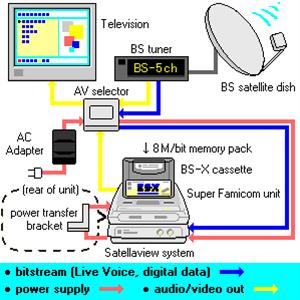
This diagram roughly shows how the Satellaview system operates
The Satellaview required a subscription to St GIGA satellite radio station in order to access content. Broadcasting began in April 23 1995 which compromised of downloadable exclusive games, re-released Super Nintendo games, re-mixed Super Nintendo games, original BS-X games and gaming news. Online services and viewable content was restricted by a time window with access only available between the hours between 4:00 and 7:00 PM. The majority of these downloadable games were so exclusive that they never made it to any other format and all opportunities to obtain these exclusive games ended on June 30, 2000 when broadcasting ceased.
Satellaview Deluxe kit Contents
- Satellaview adapter
- L-shaped SNES power supply bracket
- BS-X Application cartridge
- 8-Megabit Memory Pak
Japanese advertisement for the Satellaview
Super Game Boy
Super Gameboy NTSC version
The Nintendo Gameboy was a smash hit portable gaming system that sold millions of units world wide and was backed up by a extensive gaming library loaded with top quality games. In 1994 Nintendo gave Super Nintendo owners the option of taking their favourite portable games off the small monochrome screen and onto the big colour television with stereo sound by using the Super Gameboy peripheral. The Super Gameboy contains the standard Gameboy hardware in an over sized SNES cartridge with the only technical difference in hardware being that the Super Gameboy was 2.4% faster, a sensitive ear could notice the increased music pace. Not only did it allow Gameboy games to be played through the SNES it also allowed a certain level of customization and enhancements depending on which game. When a Gameboy game is inserted into the Super Gameboy the user is given the option of replacing the four shades of greyscale with any desired colour. The Super Gameboy didn’t utilize the entire television screen instead the game image was displayed with a surrounding border. The classic Gameboy being the default screen border but nine pre loaded borders were available and the option to customize one of your own using the provided art program. After the release of the Super Gameboy some game developers branded their game packaging with the Super Gameboy insignia indicating that the game was also optimized for that peripheral allowing more colour options and the occasional hidden feature. Four years later Nintendo released the Super Gameboy 2 in Japan which was essentially the same as its predecessor but wrapped in a transparent case with the addition of the multiplayer game link feature, extra borders and LED status indicators.
Super Gameboy 2 Menu Interface
Note: The Sega Meagdrive was renamed the Sega Genesis in the US and to minimise confusion I will be referring it as the Sega Megadrive throughout the article.
The Sega Megadrive also had a expansion port under the unit but located more towards the right hand side of the Megadrive. When Sega’s “Blast Processing” advertisement campaign wasn’t wowing consumers anymore and with Nintendo beginning to loom ahead with the Super Nintendo Sega resorted to multiple hardware add-ons that enhanced the performance of the Megadrive. Many criticized Sega for all format changing add-on hardware released for the Megadrive often referring to them as life support. The reference to life support does make sense in a way as anyone who has seen a fully assembled Megadrive, Mega CD and 32X combo along with the individual power sources and link-in cable would agree to this, as the combination does look quite chaotic. Even though it wasn’t the neatest and cost effective method of producing better games a hand full of quality titles did emerge but it wasn’t enough to make these add-ons sell successfully.
The expansion port on the Sega Mega Drive/Genesis
Sega Mega CD
The Mega CD was the first of the hardware add-ons for the Megadrive that enhanced the consoles performance and introduced CD-ROM technology to the Megadrive. First appearing in Japan in 1991 where it was pitted against the TurboGrafx-16 and its CD-ROM add-on which already had a strong established user base. Only around 11 percent of Japanese Megadrive owners purchased the add-on. It was later released in the US in 1992 then Europe and Australia in 1993 where it struggled to sell in big numbers because consumers were not convinced that the heavy price tag justified the minimal hardware advancements over the original Megadrive. How ever the Mega CD did a little better in the US thanks to bigger game library on launch day compared to the Japanese release plus the Megadrive was already a popular console at the time backed by a large user base.
Adaptor plate and the connection on the Mega CD
A large portion of the Mega CD game library consisted of FMV(Full Motion Video) games that were basically interactive movies that only required basic button presses at the correct time to advance though the game. Sega insisted on pushing this type of game out even though the Mega CD was not properly equipped to handle FMV mainly due to its limited 64 colour palette. The majority of these FMV games have a viewing window that only used a small portion of the screen and displaying a grainy low resolution image. A few really good titles did emerge on the Mega CD one of them being Sonic CD and even to this day Sonic CD is still hailed as one of the all time best Sonic games of the series. A good combination vibrant graphics, brilliant CD quality soundtrack and fasted paced easy to control game play made this game a hit. The popular RPG series Lunar The Silver Star and Lunar Eternal Blue was an exclusive to the Mega CD and became a cult classic with many other games in the series continuing on other platforms later on.
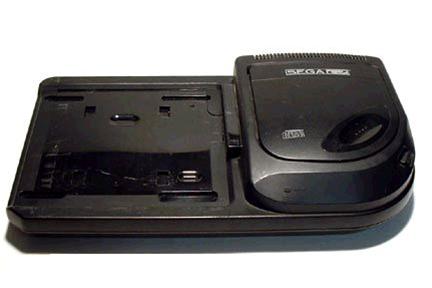
The second version of the Mega CD
Multiple versions of the Mega CD add-on was released and various combination systems as well. A front loading Mega CD (top image of this section) was designed specifically for the Original Megadrive, this version was also compatible with Megadrive 2 but when combined it look out of place due difference in size between the systems. A second version called the Mega CD 2 (pictured above) was a top loading unit designed for the Megadrive 2, this version was compatible with the original Megadrive but required a base plate extension to stop the Megadrive from over hanging.
A Sega Mega-CD module was made for Pioneer LaserActive which was a laser disc based gaming console created by Pioneer in the early 90s. The JVC Wondermega was a combination of both Megadrive and the Mega CD but with a lot more added features and options. The Sega Multi-Mega also known as CDX in the US was another combination Megadrive and Mega CD system that actually was more expensive to buy than the two units on their own.
Sega Mega CD Technical Specifications
- CPU
The main CPU is a 12.5-MHz 16-bit Motorola 68000 processor.
- Graphics Graphics Processor: Custom ASIC Graphics Processor. Number of simultaneous colours on screen: 64 out of 512. Display resolution: 320 x 224 pixels and 256 x 224, video size from ¼ to full screen. Advanced compression scheme. Software-based upgrade. Scaling and rotation effects
- RAM Main RAM: 6 Mbit. PCM samples: 512 kbit. CD-ROM data cache: 128 kbit. 64 kbit Internal Backup RAM.
- Storage 500 MB CD-ROM discs (equivalent to 62 minutes of audio data). ¼ screen B/W footage video: 1.5 to 4 hours. ¼ screen colour footage: 45 minutes. CD-ROM drive transfer rate: 150 kkB/s (1x)
- BIOS Size: 1 MBit. Used for games, CD player, CD+G and karaoke. Access time: 800 ms.
- Audio Additional 10 extra sound channels to the Mega Drive's YM2612 and SN76489 using the Ricoh RF5C164 chip. Sound format: Stereo PCM. Clock frequency of source: Up to 12 MHz. Sound channels: 8. Maximum sample rate: 32 kHz (44.1 kHz for CD-DA). Wave data width: 8 bits. 16 bit DAC. 8x internal over-sampling digital filter. Frequency Range: 20 Hz - 20 kHz. Signal-to-Noise Ratio: > 90.0 dB @ 1K. Channel Separation: > 90.0 dB. Output: RCA stereo Pin Jack x2 (L/R) / SCART cable. Mixing Input Port for sound on the original Sega Mega Drive / Gensis Model via the RCA jacks on the back of the Sega CD unit.
- Dimensions301 mm × 212.5 mm × 112.5 mm. Weight: 1.4 kg (3.1 lb).
Sega 32X
The Sega Megadrive/Genesis 32X also known as the Sega Super 32X in Japan was a hardware add-on that plugged into the cartridge slot of the Megadrive which worked together with Megadrive to produce 32bit graphics and improved audio. First appearing in 1994 the 32X needed its own separate power supply identical to the one used by the Megadrive and a video feed cable between the two units to operate.
Sega introduced the Sega 32X add-on to further extend the life the Megadrive while their soon to be released Sega Saturn could establish a strong user base but consumers recognised Sega’s ploy and avoided purchasing the 32X add-on and just held out for the Saturn which was only a few months away from its US launch. In addition to this the 32X was plagued with technical problems both software and hardware. Many games were uncompleted and had program errors this was due to developers rushing out games for the 1994 Christmas launch. One title that notably suffered from a rushed release was the PC classic Doom which had half the levels missing and suffered from poor quality sound, even the Super Nintendo version had all the levels and better quality sound although the 32X version was graphically superior. If development on Doom was completed properly by including all the game levels and taking advantage of the 32X Q-Sound audio system which is technically superior to the SNES audio system it would have been a much better port compared to the FX chip powered Super Nintendo version. The Master System Converter and the SVP powered game Virtua Racing was incompatible with the 32X pass through system that only used connections pins that are necessary to play games. Another negative point about the 32X is its physical design; first of all it’s not aesthetically pleasing in appearance when inserted into the Megadrive and second there were some compatibility issues. Depending on the version of Megadrive an adaption plate may be required for secure fitment and due to the increased height of the combined systems an accidental tip over could easily happen.
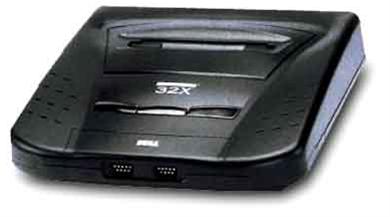
Sega did have an all in one combination of the Megadrive and 32X system in the pipeline. Continuing with the tradition of Sega naming their consoles after planets the combined unit was named the Sega Neptune and was due for release late 1994/early 1995 but the project was scrapped after Sega realised the 32X wasn’t living up to its original intentions further more the Sega Saturn was just about to hit the shelfs world wide.
A small amount of titles were released that required both the 32X and the Mega CD
Sega 32X Technical Specifications
- Processor: Two SH2 32-bit RISC processors with a clock speed of 23.011 MHz, approx 20 MIPS each
- Video RAM: Two linear framebuffers with support for RLE compression and an overdraw mode to simplify compositing objects with transparency. All scaling, rotation, and 3D operations are performed in software on the SH2 processors.
- ROM (BIOS): 3 Kb
- Colour depth: 32,768 simultaneous colours on screen at standard Mega Drive resolution. Video output can overlay Mega Drive graphics or vice versa. Mega Drive video effects such as shadow or highlight do not affect 32X video.
- Memory: 256KB (2 MBit) program RAM and two 128KB (1 MBit) framebuffers.
- Audio: Stereo 10-bit PWM mixing with Mega Drive sound for a total of 12 audio channels of varying capability, 22 with the addition of a Mega-CD/Sega CD.
- I/O: Same as Mega Drive/Genesis.
- Storage: 32X cartridges are fundamentally the same as Mega Drive/Genesis cartridges with some small differences in the plastic casing. A few CD-ROM games were developed that also required a Mega-CD/Sega CD.
- Size & weight (more or less) : 107x205x110 mm 495 grams
- Units Sold: 200,000
Master System Converter / Power Base Converter
Unlike the Super Nintendo the Megadrive was backwards compatible with its predecessor console. The entire library of Master System games excluding one title could be played on the Megadrive through the Master System Converter. Due to Sega basing the Megadrive’s architecture on the Master System the Master system converter was basically a pass through device that accommodated the difference in game pack design. Card based games and the 3-D glasses adapter from the first version Master System could still be used via the front slot. The only problem to arise was with a incompatibility issue with the second revision of the Megadrive, this was solved with the release of the Master System Converter 2 that was specifically designed for the Megadrive 2.
The Turbo Grafx-16 other wise known as the PC Engine in Japan was a combined effort between NEC and Hudson Soft and was marketed as a 16bit console although it did have an 8bit CPU it was supported by a 16-bit graphics chip. There was no official Australian PAL release of the Turbo Grafx-16 and the only way to obtain one was though an importer so many people may not have been too familiar with the system until Turbo Grafx-16 games became available on the Wii’s Virtual Console.
A single speed multimedia CD-ROM add-on was released for the Turbo Grafx-16 in 1989 and was the first home console to have such an accessory and utilize the larger and much cheaper storage medium of CDs. The US version had the CD drive attach at the rear of the unit while the Japanese version was sat beside the unit. Even though the Turbo Grafx-16 CD had an expensive price tag and a slow growing game library it was still quite successful in Japan. American owners had an even smaller selection of games but thanks to the systems lack of region coding games could be imported over from Japan. The Turbo Grafx-16 plus it CD-ROM add-on was replaced by a Duo combination system first in Japan in 1991 then followed by a US version in 1992. The Duo system was compatible with all previous Turbo Grafx-16 formats and came equipped with Super System BIOS plus an extra 192k RAM built-in to the motherboard.